
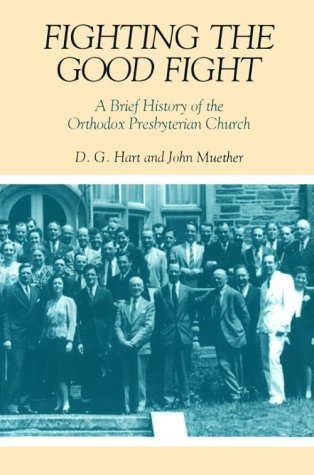
 The founding and subsequent growth of the Orthodox Presbyterian Church is the story of a denomination’s sincere desire to maintain faithfulness to the Scriptures and their Reformed summation as contained in the Westminster Standards. It’s a story of how this desire was born, as it were, through a period of intense pangs. D.G. Hart and John Muether capture this story in their book, Fighting the Good Fight: A Brief History of the Orthodox Presbyterian Church.
Not so different from the men’s other work, Seeking a Better Country, Fighting the Good Fight again emphasizes the need for identity. For they state in the introductory pages, “Above all, we hope that this book will challenge the church to think hard about its identity. For we believe that a church without an identity will lose its reason for existence.” For the OP Church, finding this identity has not come easy. In fact, the title of this work captures the essence of the OPC’s existence: fight the good fight. This is both a reference to the Apostle Paul’s words to his young disciple, Timothy, in I Timothy 6:12 and to the words of the denomination’s principle founder, J. Gresham Machen when he referred to the necessity to maintain the “ecclesiastical fight.”
In I Timothy, Paul exhorts Timothy to fight the good fight, that is, to agonize the good agony, in maintaining a pure doctrine. He was to “immerse (himself) in it.” Hart and Muether capture the heart of the agony with which the OPC has agonized to maintain fidelity to the Scriptures and the Westminster Standards. To Machen and this denomination in which he played a major role, these words to Timothy have been taken as if to them-as well they should be!
The authors begin the book with a brief history of the OPC’s beginnings and then seek to lay out the elements which define the denomination as unique, even amongst other Presbyterians. These elements are: its view of and strategic planning around missions, its particular view of ecumenicity, and the character of the church’s ministry.
In the 1920’s and 1930’s, the northern Presbyterian mainline church was embroiled in a dispute over doctrines fundamental to Christian identity. In particular, liberalism had gained a firm foothold within northern Presbyterianism. As the author’s state, “But the controversy that erupted at the 1920 General Assembly revealed widespread ambivalence within the church and the denomination’s seminaries about the central convictions of Presbyterian faith and practice” (16). The book documents the content of this controversy as a feud over what was truly essential to biblical Christianity. From the liberal perspective, an effective modern church could not place much emphasis on doctrine, but should instead appeal to Christian experience in order to maintain unity. For Greshem Machen and the conservatives, however, without emphasis on doctrine as expressed in the Westminster Standards, the church would abandon its faithfulness to the truth. “It was a departure from that high view of Scripture and a substitution of the word of man for the Word of God in the Presbyterian Church during the fundamentalist controversy that led to the exodus from that body and to the formation of the OPC” (17).
The issue of fidelity to Scripture, the authors note, was played out in the arena of missions. Because of the overwhelming support for an expanded influence of the church on society, an emphasis on sound theology was jettisoned by the denomination. In response, in 1933 Machen “overtured the general assembly to instruct the missions board to do all in its power to insure that sound missionaries and doctrine were characteristic of its activities” (30). This overture, in a remarkable display of contempt for the whole of Scripture, was defeated, and led to Machen’s formation of the Independent Board for Presbyterian Foreign Missions. Based on this action, the PCUSA recommended Machen’s suspension of ministry, which charge was upheld in 1936. In June 1936, “ten days following the close of the general assembly (in which the charges were upheld)…the OPC was constituted with thirty-four ministers and seventeen elders” (37).
As missions was an area of intense debate which led up to the formation of the OPC, this became one of the primary tenants of that denomination’s vision for ministry. “The OPC maintained a high commitment to reaching the lost with the good news of Christ through the God-ordained means of establishing churches characterized by the preaching of the Word, the administration of the sacraments, and the exercise of discipline” (57). In other words, the denomination believed the ordinary means were the correct formula for carrying out the Gospel commission. Faithfulness to Scripture, as captured in the Westminster Standards, was the objective, not growth. Conversely, though, the authors are quick to note that “the church must be wary of proudly boasting of its small size as a sign of its unswerving fidelity to the truth” (39).
This is an appropriate point to note the character and influence of J. Gresham Machen. Summarizing the development and formation of the OPC is also a summary of the later years of Machen’s life. The two are inseparable. Hart and Muether present him as a man who had great courage in the face of significant opposition. It was not long after the formation of the OPC that he found himself, yet again, in the heat of battle over doctrinal accuracy over the issue of dispensationalism. Discussing this challenge, the authors write, “Machen had a history of resisting compromise with all his might and main when the basic positions of the Reformed faith were being attacked” (52). On the one hand, Machen fought tenaciously for a confession of faith that aligned with the teachings of sacred Scripture, but on the other hand, he demonstrated an understanding of the need for church unity. When, in November 1936, the OPC found itself in a debate over dispensationalism, “Machen tried to keep the two sides together, despite his own Old School sympathies, and orchestrated the election of J. Oliver Buswell as moderator” (47). Buswell was a leader of the premillenialist side of the OPC in this debate. This anecdote shows the fine balance that must be pursued by a man of valor such as Machen was. Fidelity to Scripture and unity are both important to the vitality of the church.
In addition to missions, the authors identify the OPC’s particular mode of ecumenicity as a key identifying element. The denomination, partly because of the circumstances surrounding its founding, has been labelled by some as “anti-ecumenical.” This though is not the case. “The OPC, as it turns out, has not been anti-ecumenical but rather has pursued ecumenicity for very different reasons from those of mainline Protestantism. It has sought fellowship with other communions not out of sentimental and vague ideals of good will and Christian brotherhood, but rather on the basis of its commitment to the Reformed faith” (102). The pursuit of unity has been at the forefront of American Presbyterian church history. Sadly, ecumenism has often trumped faithfulness to Scripture as the “essential doctrines” have become narrower and narrower in order to fit a broader view of brotherhood. The OPC has rightly understood that “doctrine and common confession is the basis of unity and fellowship with other Christians,” and that “what unites the church to other Reformed communions is a common confession about the Lord of glory, the riches of God’s love in Jesus Christ, and the nature and means of salvation offered in the gospel” (103).
Finally, the OPC is distinguished by its commitment to the education of its membership and to a Reformed liturgy of worship. Despite resources more meager than some of its Presbyterian cousins, the OPC has vigorously pursued the education of its members through the publication of substantive teaching materials. Its covenantal identity emphasizes and encourages the role of the family in this education over against the emphasis on Sunday School and other church programs found in wider evangelicalism. With regard to worship, the OPC again stands in contrast in its emphasis upon observance of the Sabbath and adherence to the regulative principle.
As with their work on the history of American Presbyterianism, Fighting the Good Fight captures the essence of the struggle for a church which relies on men for leadership. To greater and lesser degrees, all men are self-seeking. This frailty of human sinfulness is exhibited in the frequent disputes which arise within the church as she struggles to maintain faithfulness to God in Christ. The book is also another good ministerial reminder that God is always faithful to raise up men like Greshem Machen through whom he calls us to faithfulness. The Church will continue to face controversy until the coming of Christ in glory, and, as the authors state, “the origins and early history of the OPC remind us that the challenges which confronted the church’s first generation were no less staggering that those encountered at the close of the twentieth century” (194). Christ has promised to build his church, and instances like that of the founding of the OPC are a reminder of his faithfulness to this promise.
 500 Words
Leave a comment